Weight Estimation of Asian Sea Bass (Lates calcarifer) Comparing Whole Body with and without Fins using Computer Vision Technique
DOI:
https://doi.org/10.48048/wjst.2021.9495Keywords:
Computer vision technique, Fin, Weight estimation, Whole body, Asian sea bass, Image processingAbstract
An optimal model to evaluate the weight of the whole body of Asian sea bass with and without fins was generated using computer vision image processing techniques. Image data of 25 fish randomly selected were collected every week for one month. The data were divided into two sets by means of a 40 - 60 % split-test, 40 % (10 fish; 100 images) were used as training data and 60 % (15 fish; 150 images) were used as out-samples or validation data. The model using fish images without fins gave a higher average and total coefficient of determination (N150R2 = 0.77 ± 0.10, N600R2 = 0.96) than using images with fins (N150R2 = 0.24 ± 0.20, N600R2 0.63). Errors as root mean square error (RMSE), mean absolute error (MAE), mean absolute relative error (MARE), maximum absolute error (MXAE), and maximum relative error (MXRE) were compared using mathematical models. Results showed that the model using fish images without fins recorded fewer errors, with average values of 9.19 ± 3.74 g, 6.06 ± 3.64 g, 5.18 ± 3.08 %, 8.87 ± 3.26 g and 0.12 ± 0.12 %, respectively compared with fish images with fins at 12.35 ± 4.45 g, 11.26 ± 3.61 g, 9.69 ± 2.94 %, 11.50 ± 4.71 g and 0.14 ± 0.11 %, respectively. Comparison between models, with and without fins, and normal manual measurement methods found no statistically significant differences (P > 0.05). Therefore, this technique may be applied for weight estimation in real pond conditions to give advantages of reduced time, stress and injury, with minimal interference in fish feeding compared to physical capture and weighing.
HIGHLIGHTS
- 2D Computer vision techniques can be applied for fish weight estimation
- Fish images without fins show better results than those of with fins
- The advantages of this technique are reduced time, stress and injury compared to physical capture and weighing
- Step toward development of an automatic fish weight monitoring when the fish is swimming freely in the water
GRAPHICAL ABSTRACT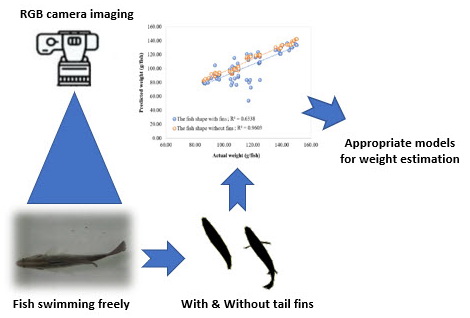
Downloads
References
Department of Fisheries. Fishery statistical analysis and research ground. Information and Communication Technology Center, Department of Fisheries, 2019.
AD Pickering and P Christie. Changes in the concentrations of plasma-cortisol and thyroxine during sexual-maturation of the hatchery-reared brown trout, Salmo trutta L. Gen. Comp. Endocrinol. 1981; 44, 487-96.
GW Klontz. Producing a marketable fish. Part V. Inventory techniques. North. Aquac. 1993; 10, 21-5.
TA Beddow, LG Ross and JA Marchant. Predicting salmon biomass remotely using a digital stereo-imaging technique. Aquaculture 1996; 146, 189-203.
NK Newlands and TA Porelli. Measurement of the size, shape and structure of Atlantic bluefin tuna schools in the open ocean. Fish. Res. 2008; 91, 42-55.
S Torisawa, M Kadota, K Komeyama, K Suzuki and T Takagi. A digital stereo-video camera system for three-dimensional monitoring of free-swimming pacific bluefin tuna, Thunnus orientalis, cultured in a net cage. Aquat. Living Resour. 2011; 24, 107-12.
JM Miranda and M Romero. A prototype to measure rainbow trout’s length using image processing. Aquacult. Eng. 2017; 76, 41-9.
MO Balaban, GFÜ Sengor, MG Soriano and EG Ruiz. Using image analysis to predict the weight of Alaskan salmon of different species. J. Food. Sci. 2010; 75, 157-62.
S Viazzi, SV Hoestenberghe, B Goddeeris and D Berckmans. Automatic mass estimation of jade perch Scortum barcoo by computer vision. Aquacult. Eng. 2015; 64, 42-8.
DA Konovalov, A Saleh, JA Domingos, RD White, DR Jerry. Estimating mass of harvested Asian seabass Lates calcarifer from images. World J. Eng. Tech. 2018; 6, 15-23.
GS Jamerlan and RM Coloso. Intensive culture of seabass Lates calcarifer Bloch, in brackish water Earthen ponds. Southeast Asian Fisheries Development Center, Aquaculture Department, Tigbanan, Iloilo, Philippines, 2010.
JA Madrones-Ladja and MR Catacutan. Net cage rearing of the Asian seabass Lates calcarifer (Bloch) in brackish water Pond. Philipp. Aqric. Sci. 2012; 95, 79-86.
ImageJ, Available at: http://imageJ.nih.gov/ij/, accessed September 2019.
B Zion. The use of computer vision technologies in aquaculture: A review. Comput. Electron. Agr. 2012; 88, 125-32.
AFA Fernandes, EM Turra, ERD Alvarenga, TL Passafaro, FB Lopes, GFO Alves, V Singh, GJM Rosa. Deep learning image segmentation for extraction of fish body measurements and prediction of body measurements and prediction of body weight and carcass traits in Nile tilapia. Comput. Electron. Agric. 2020; 170, 105274.
C Costa, F Antonucci, C Boglione, P Menesatti, M Vandeputte and B Chatain. Automated sorting for size, sex and skeletal anomalies of cultured seabass using external shape analysis. Aquacult. Eng. 2013; 52, 58-64.
E Misimi, U Erikson and A Skavhaug. Quality grading of Atlantic salmon (Salmo salar) by computer vision. J. Food. Sci. 2008; 73, 211-7.
Downloads
Published
How to Cite
Issue
Section
License
Copyright (c) 2021 Walailak University

This work is licensed under a Creative Commons Attribution-NonCommercial-NoDerivatives 4.0 International License.