Effect of Acidic and Basic Conditions on the Plasmon Band of Colloidal Silver
Keywords:
Colloidal silver, UV-visible spectroscopy, acidic and basic conditions, plasmon bandAbstract
Preparation of colloidal silver nanoparticles has been carried out by salt reduction method and confirmed by the appearance of plasmon band in the visible region. The prepared nanoparticles were subjected to acidic and basic environments. The plasmon band was studied as a function of time under the described conditions and hence used as a stability check of silver nanoparticles in different media. The mechanism of plasmon band disappearance of silver colloids was found to depend strongly on the pH of the medium.
Graphical abstract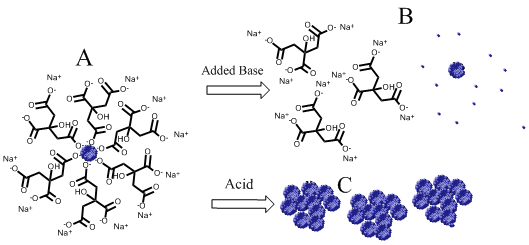
Research highlights
► Plasmon band of silver nanoparticles formed by citrate reduction method is strongly affected by the acidic and basic environments demonstrating effect of pH on the structure and stability of citrate caped silver nanoparticles. ► In acidic condition, an accelerated particle growth results only limited by the buffer action of citrate in solution. ► In the case of base Ag+ ions formation take place which ultimately deposit on the walls of test tube forming a silver mirror.
Downloads
References
O Tzhayik, P Sawant, S Efrima, E Kovalev and JT Klug. Xanthate capping of silver, copper and gold colloids. Langmuir 2002; 18, 3364-9.
KG Scheckel, TP Luxton, AM El Badawy, CA Impellitteri and TM Tolaymat. Synchrotron speciation of silver and zinc oxide nanoparticles aged in a Kaolin suspension. Environ. Sci. Tech. 2010; 44, 1307-12.
AM El Badawy, RG Silva, B Morris, KG Scheckel, MT Suidan and TM Tolaymat. Surface charge-dependent toxicity of silver nanoparticles. Environ. Sci. Tech. 2010; 45, 283-7.
KG Scheckel, TP Luxton, AM El Badawy, CA Impellitteri and TM Tolaymat. Synchrotron speciation of silver and zinc oxide nanoparticles aged in a kaolin suspension. Environ. Sci. Technol. 2010; 44, 1307-12.
FM Kelly and JH Johnston. Colored and functional silver nanoparticle-wool fiber composites. ACS Appl. Mater. Interfaces 2011; 3, 1083-92.
D Wodka, Eb Bielańska, RP Socha, M Elżbieciak-Wodka, J Gurgul, P Nowak, P Warszyński and I Kumakiri. Photocatalytic activity of titanium dioxide modified by silver nanoparticles. ACS Appl. Mater. Interfaces 2006; 2, 1945-53.
J Jain, S Arora, JM Rajwade, P Omray, S Khandelwal and KM Paknikar. Silver nanoparticles in therapeutics: development of an antimicrobial gel formulation for topical use. Mol. Pharm. 2006; 6, 1388-401.
PS Vijayakumar and BLV Prasad. Intracellular biogenic silver nanoparticles for the generation of carbon supported antiviral and sustained bactericidal agents. Langmuir 2009; 25, 11741-7.
C Tiller Jörg. Silver-Based Antimicrobial Coatings, Polymeric Drug Delivery II, American Chemical Society, Washington DC, 2006, p. 215-31.
DJ Anderson and M Moskovits. A SERS-active system based on silver nanoparticles tethered to a deposited silver film. J. Phys. Chem. B 2006; 110, 13722-7.
RM El-Shishtawy, AM Asiri and MM Al-Otaibi. Synthesis and spectroscopic studies of stable aqueous dispersion of silver nanoparticles. Spectrochim. Acta A 2011; 79, 1505-10.
A Sileikaite, I Prosycevas, J Puiso, A Juraitis and A Guobiene. Analysis of silver nanoparticles produced by chemical reduction of silver salt solution. Mater. Sci. 2006; 12, 287-91.
P Mukherjee, A Ahmad, D Mandal, S Senapati, SR Sainkar, MI Khan, R Parishcha, PV Ajaykumar, M Alam, R Kumar and M Sastry. Fungus-mediated synthesis of silver nanoparticles and their immobilization in the mycelial matrix: a novel biological approach to nanoparticle synthesis. Nano Letters 2001; 1, 515-9.
Downloads
Published
How to Cite
Issue
Section
License
Copyright (c) 2012 Walailak University

This work is licensed under a Creative Commons Attribution-NonCommercial-NoDerivatives 4.0 International License.